
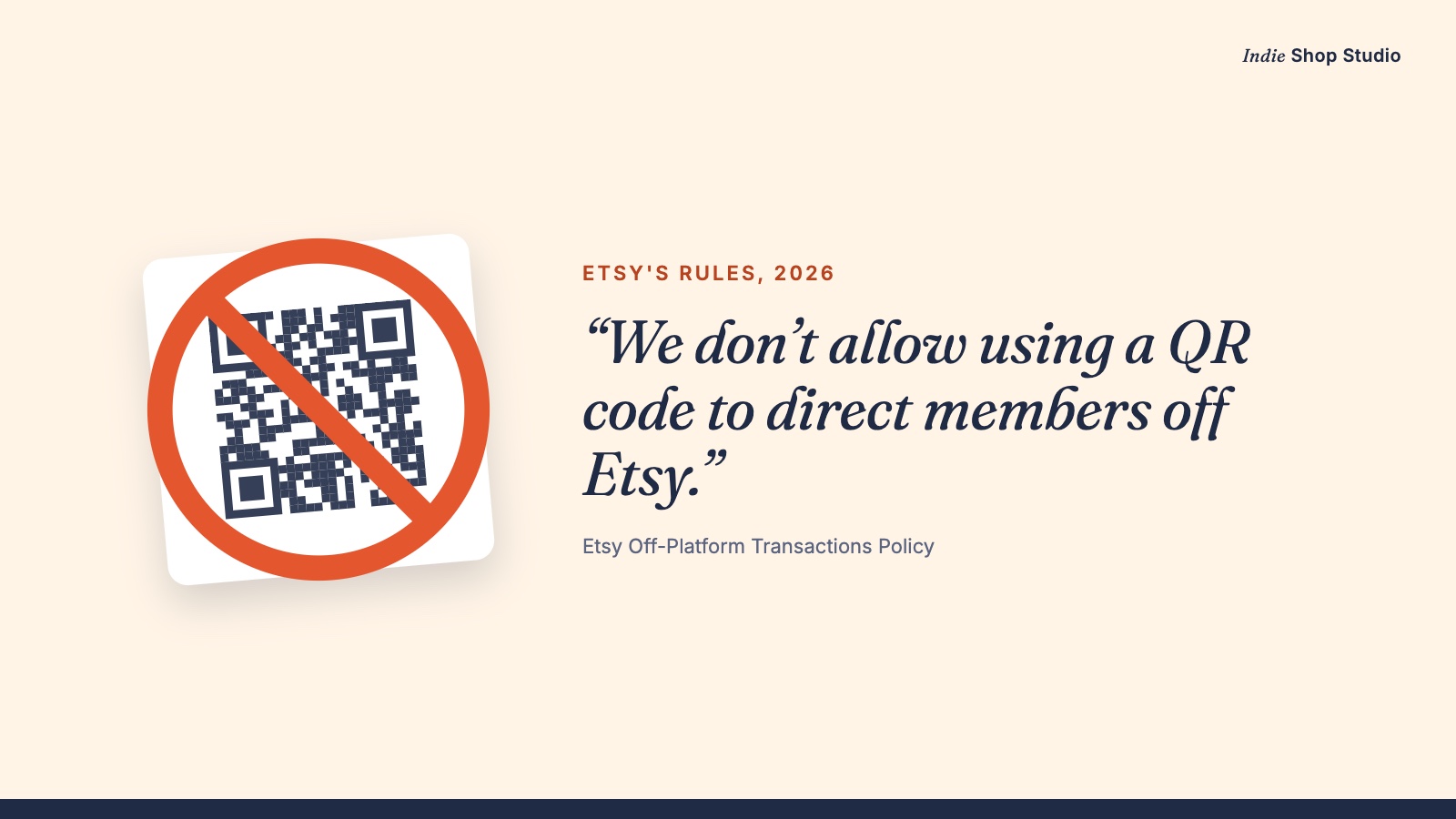
I was writing a post about how to bring people to your new online store, and one of my favourite tips was the humble insert card: a thank-you, your web address and a QR code, tucked into every package.
Then I went to check Etsy's current rules, as I do before I tell anyone anything about Etsy, and found this line in its Off-Platform Transactions Policy:
"We don't allow using a QR code to direct members off Etsy."
I sell on Etsy myself, and I hadn't noticed it. I'm guessing a lot of you haven't either.
What the rule says
Etsy's Off-Platform Transactions Policy (the page says it was last updated October 5, 2026) lists four things it doesn't allow:
- Off-platform payment or direction. Telling a buyer to pay or buy somewhere else, including "a personal website".
- Sharing contact details to complete a sale off Etsy. Phone, email or social handle, when the point is to finish the sale elsewhere.
- Incentives to shop off-platform. Etsy names "off-platform discounts, free items, cheaper shipping, or other financial incentives".
- QR codes. The line above, with no conditions attached.
Is it actually new?
Partly. QR codes have been in Etsy's rules for a while: the Seller Policy that was in force until July 8, 2026 already listed them alongside phone numbers, emails and external links as things you can't exchange for the purpose of making a sale off Etsy.
What's different is how plainly it's now written. The old wording was about purpose: a QR code used to take a sale elsewhere. The current policy has a separate heading that just says QR codes, and a sentence that doesn't mention sales at all. Read literally, any QR code that sends an Etsy buyer anywhere off Etsy is out. I can't tell you the exact day that sentence first appeared, but it's there now, and Etsy can enforce what's on the page.
What it means for your packaging
The policy doesn't mention packaging inserts by name. But a QR code on a card in an Etsy order directs an Etsy member somewhere, and if it comes with a discount for your own store, it hits two of the four rules at once. I wouldn't bet a shop on the argument that "it was printed, not online".
The penalty isn't small. Etsy's Seller Policy says it can remove content or suspend or close your account for breaking its rules, including accounts it considers related.
Why I think it's the wrong call
Etsy's stated reason is buyer protection: its payments, purchase protection and case system only cover sales made on Etsy, so it doesn't want buyers lured into deals elsewhere. That's a fair concern for scams in Etsy Messages. It's a poor fit for a thank-you card in a box.
The Etsy sale is already done. By the time a buyer opens the parcel, they've paid through Etsy, Etsy has taken its fees, and the order is fully protected. A card in that box doesn't remove protection from anything.
A maker's packaging is their brand. You designed the item, made it, wrapped it and paid for the postage. Saying "here's where else you can find me" is the most ordinary thing a small business does. Treating that as a threat tells makers Etsy sees their customers as its customers.
The sentence is too broad to follow with confidence. "Direct members off Etsy" doesn't only cover your store. Taken literally, it covers a QR code linking to a video on how to care for your wooden board, your Instagram, or a page explaining how to wash a knitted hat. I doubt Etsy means all of that, but the rule doesn't say, and "I doubt they mean it" isn't something to stake your income on.
Most sellers will only find out when it's too late. Policy pages get updated, and few of us reread them. A rule this specific, with a penalty this serious, deserves a clear notice in every seller's dashboard.
I don't think Etsy is evil. It's a marketplace protecting its marketplace. But it's a good reminder of who writes the rules on someone else's platform.
What you can still put in an Etsy package
Without any worry:
- A handwritten or printed thank-you note
- Care instructions
- Your Etsy shop address (Etsy's trademark examples say this is fine on a business card; just don't use Etsy's logo)
- A friendly request to leave a review on Etsy
- A small freebie or sample that isn't tied to buying somewhere else
Grey areas, where Etsy hasn't given a clear answer:
- A printed social handle "to follow along". The contact-sharing rule is about completing a sale elsewhere, so a follow-me handle is probably fine, but the QR line shows how broad Etsy's wording can get.
- Any QR code at all, even one pointing at care instructions or a video.
If you want certainty, ask Etsy Seller Support and get the answer in writing. Keep it.
If you decide to keep using QR codes
Some sellers will keep using QR insert cards in Etsy orders. I'm not going to pretend that's safe. The wording covers it, and the penalty is your account. If you weigh that and decide the card is worth it, that's your call to make. Just make it knowing the rule is there, not because nobody told you.
Where the QR card is still a great idea
Everywhere that isn't an Etsy order:
- Orders from your own online store
- Craft fair and market bags
- Wholesale and consignment boxes
- Commissions and direct orders
That's one more reason to have a place of your own next to your Etsy shop. It's where your packaging, your rules and your customer list are actually yours. I wrote up how to bring people to it, the Etsy-safe way.
Thinking about a store of your own, alongside Etsy? Start with a free shop check.